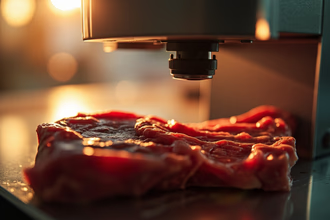

Near-Infrared (NIR) analysis is a method used to identify the composition of a sample. It uses the near-infrared region of the electromagnetic spectrum. This technique is used across many industries because it is fast, non-destructive, and requires little to no sample preparation.
This article provides an overview of NIR analysis, discussing its core principles, diverse applications, and key benefits. It will help you understand how NIR analysis works and why it is a valuable tool for material analysis.
Key Takeaways
- NIR analysis is a rapid, non-destructive spectroscopic technique used for material analysis based on the interaction of near-infrared light with molecular vibrations.
- Different materials have unique NIR spectra, which serve as fingerprints for material identification and quantification.
- NIR analysis is applied across various industries, including food and beverage, pharmaceuticals, agriculture, and polymers, for quality control, composition analysis, and material identification.
- Compared to traditional methods, NIR analysis offers advantages such as faster analysis times, minimal sample preparation, and cost-effectiveness.
- NIR analysis has limitations, including lower sensitivity compared to other spectroscopic methods and the need for calibration models.
- The future of NIR technology includes miniaturization, improved data analysis techniques, and expanding applications in areas such as environmental monitoring and medical diagnostics.
Table of Contents
Introduction to NIR Analysis

NIR analysis is a spectroscopic technique used for rapid and non-destructive material analysis. It relies on the near-infrared region of the electromagnetic spectrum. This region sits between visible light and mid-infrared light. When NIR radiation interacts with a substance, molecules within that substance absorb and reflect energy at specific wavelengths. By measuring these absorption and reflectance patterns, we can identify and quantify the components of the material. This article will explore the principles behind NIR analysis, its diverse applications across various industries, and the benefits it offers.
The Science Behind Near-Infrared Spectroscopy
NIR spectroscopy is based on the interaction of near-infrared light with molecular vibrations. Molecules are not static; their atoms vibrate in various modes. When NIR light interacts with a molecule, the molecule absorbs energy if the frequency of the light matches the frequency of a specific vibrational mode. This absorption is not as direct as in mid-infrared spectroscopy. Instead, NIR absorption primarily involves overtones and combination bands.
Overtones are vibrations that occur at multiples of the fundamental vibrational frequency. Combination bands arise from the simultaneous excitation of two or more fundamental vibrations. These overtones and combinations are weaker than the fundamental vibrations seen in mid-infrared spectroscopy, but they are still detectable and provide valuable information about the composition of a material.
Different materials have different molecular structures and compositions. As a result, they exhibit unique NIR spectra. These spectra serve as fingerprints, allowing for material identification and quantification. In NIR analysis, these unique spectral patterns are analyzed to determine the components and properties of a sample.
NIR Spectrum Example
Unfortunately, I am unable to create a visual diagram. However, a typical NIR spectrum would have:
- X-axis: Wavelength (typically in nanometers, nm) or Wavenumber (cm-1)
- Y-axis: Absorbance or Reflectance
Molecular Vibrations and NIR Absorption
The absorption of near-infrared (NIR) light is directly linked to molecular vibrations within a substance. Molecules are in constant motion, with their atoms vibrating in various modes such as stretching and bending. Each of these vibrational modes occurs at a specific frequency. When NIR radiation interacts with a molecule, the molecule can absorb energy if the frequency of the NIR light matches the frequency of one of its vibrational modes. This causes the molecule to vibrate with greater amplitude.
The energy of the absorbed NIR light corresponds precisely to the energy required to excite these molecular vibrations. These are related to what are called fundamental vibrations, which are the primary modes of vibration for a molecule. While NIR primarily measures overtones and combinations of these fundamentals, the underlying principle is the same: energy absorption due to resonant vibrations. In NIR analysis, identifying these specific absorption patterns helps determine the composition and properties of the material being analyzed.
Overtone and Combination Bands
In NIR spectroscopy, overtones and combination bands are key features of the spectra. Overtones occur when a molecule absorbs energy at a frequency that is a multiple of its fundamental vibrational frequency. For example, if a molecule has a fundamental vibration at a certain frequency, an overtone might appear at twice that frequency.
Combination bands arise from the simultaneous excitation of two or more fundamental vibrations. This means that the molecule absorbs energy equal to the sum of the energies of two or more fundamental vibrations, causing them to be excited together.
Overtone and combination bands are weaker than the fundamental vibrations observed in mid-infrared spectroscopy. This is because the probability of these transitions occurring is lower. However, they are still useful in NIR analysis because they provide additional information about the molecule's structure and composition. Examples of common overtones and combination bands include those associated with C-H, N-H, and O-H bonds, which are frequently observed in organic materials. NIR analysis utilizes these bands to identify and quantify various components within a sample.
NIR Spectra and Material Composition
Different materials yield unique NIR spectra due to variations in their molecular composition and structure. The specific types of bonds present (e.g., C-H, O-H, N-H), their arrangement, and the overall molecular structure dictate how a material will absorb and reflect NIR light. This results in a distinctive spectral fingerprint for each substance.
The intensity and position of absorption bands within the NIR spectrum offer valuable insights. The position (wavelength or wavenumber) of a band indicates the type of molecular vibration occurring, while the intensity of the band is related to the concentration of the component. By analyzing these features, NIR analysis can identify and quantify the different components within a sample.
Spectral fingerprinting involves comparing the NIR spectrum of an unknown sample to a library of known spectra. If a match is found, the unknown sample can be identified. This is widely used for quality control and material verification. For instance, water exhibits strong absorption bands around 1450 nm and 1940 nm due to O-H stretching and bending vibrations. Ethanol shows characteristic bands related to C-H and O-H vibrations. Polymers display complex spectra reflecting the various vibrational modes of their repeating units. NIR analysis uses these unique fingerprints to determine the material composition quickly and non-destructively.
Applications of NIR Analysis Across Industries

NIR analysis is used across a multitude of industries due to its speed, non-destructive nature, and cost-effectiveness. Here are some specific examples:
- Food and Beverage: In the food and beverage industry, NIR analysis is employed for quality control of incoming ingredients, moisture content analysis, and overall composition analysis. For example, NIR can rapidly determine the protein, fat, and carbohydrate content of food products. This is faster and requires less sample preparation than traditional wet chemistry methods.
- Pharmaceuticals: The pharmaceutical industry utilizes NIR analysis for raw material identification, making sure the correct materials are used in drug manufacturing. It's also used to assess tablet content uniformity, verifying that each tablet contains the correct amount of active ingredient. Also, NIR can aid in counterfeit detection by identifying discrepancies in the composition of suspected counterfeit drugs. Compared to traditional HPLC methods, NIR offers faster analysis times and requires no solvents.
- Agriculture: In agriculture, NIR analysis is used for grain analysis, determining the protein and moisture content of harvested grains. It's also applied in soil analysis to assess nutrient levels and in feed quality assessment to make sure livestock receive adequate nutrition. Compared to traditional methods, NIR provides quicker results, allowing for faster decision-making in harvesting and feeding strategies.
- Polymers: The polymer industry uses NIR analysis for material identification, verifying the type of polymer being used. It's also used for composition analysis, determining the ratio of different components in a polymer blend, and for quality control, verifying the final product meets specifications. NIR offers a non-destructive alternative to methods like DSC or TGA, preserving the sample for further testing if needed.
NIR Analysis in the Food and Beverage Industry
NIR analysis plays a crucial role in the food and beverage industry, primarily for quality control, moisture content analysis, and composition analysis. It helps make sure product quality, consistency, and regulatory compliance.
One common application is the analysis of milk. NIR can rapidly determine the fat, protein, and lactose content of milk, providing valuable information for quality control and process optimization. Similarly, in the grain industry, NIR is used to measure the protein, moisture, and oil content of grains like wheat, corn, and soybeans. This information is critical for determining the quality and value of the grain.
NIR is also used to analyze oils and fats, determining their fatty acid composition and other quality parameters. This is important for the quality and stability of edible oils.
Compared to traditional methods, NIR analysis offers several advantages. Traditional methods, such as Kjeldahl for protein determination or Soxhlet extraction for fat determination, are time-consuming, require significant sample preparation, and often involve the use of hazardous chemicals. NIR analysis, however, is rapid, non-destructive, and requires minimal sample preparation. This translates to faster analysis times, reduced labor costs, and a more environmentally friendly approach. By providing rapid and accurate data, NIR analysis helps maintain food safety and ensures compliance with labeling regulations.
NIR Analysis in the Pharmaceutical Industry
NIR analysis is an important tool in the pharmaceutical industry, used for raw material identification, tablet content uniformity testing, and counterfeit drug detection. It allows for rapid and accurate verification of the identity and quality of pharmaceutical ingredients and products.
Raw material identification is crucial in pharmaceutical manufacturing to prevent errors and make sure product safety. NIR spectroscopy can quickly verify the identity of incoming raw materials, confirming that they meet the required specifications. This helps prevent the use of incorrect or substandard materials in drug production.
Tablet content uniformity testing is another key application. NIR can assess the distribution of active ingredients within a tablet, verifying that each tablet contains the correct dosage. This is important for consistent drug delivery and therapeutic efficacy. If a tablet does not have the correct uniformity, NIR analysis is a fast way of determining this problem.
NIR spectroscopy also plays a role in counterfeit drug detection. Counterfeit medications pose a serious threat to public health, as they may contain incorrect ingredients, incorrect dosages, or even harmful substances. NIR can identify discrepancies in the composition of suspected counterfeit drugs, helping to prevent these dangerous products from reaching consumers. By providing rapid and reliable results, NIR analysis contributes to patient safety and helps pharmaceutical companies comply with regulatory requirements.
NIR Analysis in Agriculture
NIR analysis has become a valuable tool in modern agriculture, with applications in grain analysis, soil analysis, and feed quality assessment. It provides farmers with rapid and accurate information to optimize crop yields, improve livestock nutrition, and reduce costs.
In grain analysis, NIR is used to determine the protein, moisture, oil, and starch content of various grains such as wheat, corn, and barley. This information helps farmers make informed decisions about harvesting, storage, and marketing. It also allows them to optimize milling and baking processes to produce higher-quality products.
For soil analysis, NIR can assess key parameters such as organic matter content, nutrient levels, and soil moisture. This helps farmers understand the health and fertility of their soil, allowing them to tailor fertilizer applications and irrigation strategies to maximize crop growth. This is a move to more sustainable agricultural practices.
NIR is also used to evaluate the quality of animal feed, determining its protein, fiber, and energy content. This helps farmers formulate balanced diets for their livestock, improving animal health and productivity. By providing quick and reliable data, NIR analysis supports sustainable agriculture practices, promoting efficient resource use and minimizing environmental impact.
NIR Analysis in the Polymer Industry
NIR analysis offers several benefits to the polymer industry, including material identification, composition analysis, and quality control of polymers and plastics. It helps manufacturers ensure the quality and consistency of their products, improve processing, and reduce waste.
Material identification is a crucial application. NIR spectroscopy can quickly verify the identity of different polymers, distinguishing between materials such as polyethylene (PE), polypropylene (PP), and polyvinyl chloride (PVC). This helps prevent mix-ups and makes sure that the correct polymer is used for a specific application.
Composition analysis is another important use. NIR can determine the composition of polymer blends, quantifying the ratio of different polymers and additives in the mixture. This is key for controlling the properties of the final product, such as its strength, flexibility, and durability.
NIR spectroscopy can also detect defects in plastic products, such as voids, cracks, and contaminants. By identifying these defects early in the manufacturing process, manufacturers can take corrective action to prevent further production of faulty products. By providing rapid and reliable data, NIR analysis helps improve polymer processing, reduce waste, and improve the overall quality of polymer products.
Advantages and Limitations of NIR Analysis
NIR analysis offers several advantages, but it's important to also acknowledge its limitations to provide a balanced perspective.
Advantages:
- Rapid Analysis Times: NIR analysis is known for its speed. Measurements can be taken in seconds, making it suitable for high-throughput analysis and real-time process monitoring.
- Non-Destructive Nature: NIR spectroscopy does not damage or alter the sample being analyzed. This allows for repeated measurements and the preservation of the sample for further testing.
- Minimal Sample Preparation: In many cases, NIR analysis requires little to no sample preparation. This reduces labor costs and minimizes the risk of introducing errors during sample handling.
- Cost-Effectiveness: The combination of rapid analysis times, minimal sample preparation, and the absence of costly reagents makes NIR analysis a cost-effective technique.
- Simultaneous Multi-Component Analysis: NIR spectroscopy can analyze multiple components of a sample simultaneously. This is particularly useful for complex mixtures where several parameters need to be determined at once.
Limitations:
- Lower Sensitivity: Compared to other spectroscopic methods like mid-infrared or Raman spectroscopy, NIR analysis generally has lower sensitivity. This can be a limitation when analyzing samples with low concentrations of the analyte of interest.
- Need for Calibration Models: Quantitative NIR analysis requires the development of calibration models. These models relate the NIR spectra to the concentration of the components of interest. Developing and maintaining these models can be time-consuming and requires expertise.
- Matrix Effects: The NIR spectrum of a sample can be influenced by its physical and chemical environment, known as matrix effects. These effects can complicate data analysis and require careful calibration and validation.
In short, despite its limitations, NIR analysis is a useful analytical tool when applied correctly. Its speed, non-destructive nature, and ability to analyze multiple components simultaneously make it valuable in various industries.
Conclusion: The Future of NIR Technology
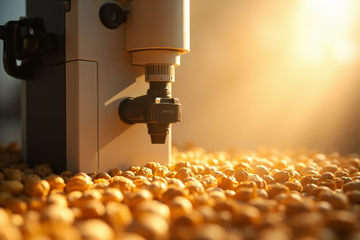
This article has explored the principles, applications, and benefits of NIR analysis. NIR analysis is a spectroscopic technique that utilizes the near-infrared region of the electromagnetic spectrum to rapidly and non-destructively analyze materials. It relies on the interaction of NIR light with molecular vibrations, providing unique spectral fingerprints that can be used for material identification and quantification.
We have discussed the diverse applications of NIR analysis across various industries, including food and beverage, pharmaceuticals, agriculture, and polymers. In each of these industries, NIR analysis offers advantages over traditional methods, such as faster analysis times, minimal sample preparation, and cost-effectiveness.
The future of NIR technology is promising, with trends pointing to miniaturization, improved data analysis techniques, and expanding applications. Miniaturized NIR spectrometers are becoming more portable and affordable, enabling on-site analysis and real-time process monitoring. Advanced data analysis techniques, such as chemometrics and machine learning, are improving the accuracy and reliability of NIR models. New applications are emerging in areas such as environmental monitoring, medical diagnostics, and security.
NIR analysis remains a valuable analytical technique due to its rapid, non-destructive, and versatile nature. Readers are encouraged to explore how NIR analysis can benefit their specific industry or application. Contact fossanalytics.com to learn more.
Frequently Asked Questions
- What industries commonly use NIR analysis, and for what purposes?
- NIR analysis is utilized across various industries, including agriculture, food and beverage, pharmaceuticals, and textiles. In agriculture, it helps in assessing crop quality and moisture content. The food and beverage industry employs NIR for determining sugar, fat, and protein content in products. In pharmaceuticals, it is used for quality control and to ensure the uniformity of active ingredients in medications. Textiles leverage NIR to analyze fiber compositions and dye concentrations.
- How does NIR analysis compare to other analytical techniques?
- NIR analysis is distinct from other techniques, such as UV-Vis spectroscopy and chromatography, in several ways. Firstly, NIR is non-destructive, allowing for rapid analysis without altering the sample. It also requires minimal sample preparation, which can save time and resources. While UV-Vis spectroscopy is effective for certain compounds, it is limited to those that absorb UV or visible light. In contrast, NIR can analyze a broader range of materials, including solids, liquids, and powders.
- What are the limitations of NIR analysis?
- Despite its advantages, NIR analysis has some limitations. It is generally less effective for materials that do not have strong NIR absorption characteristics, such as certain inorganic compounds. The technique may also require calibration for specific applications, which can be time-consuming. Additionally, while NIR can provide rapid results, the accuracy may not match that of traditional methods such as wet chemistry, especially for complex mixtures.
- What advancements are being made in NIR technology?
- Recent advancements in NIR technology include the development of portable NIR devices, making analysis more accessible in field conditions. Improvements in data processing algorithms, such as chemometrics, enhance the accuracy and reliability of NIR results. Additionally, integration with machine learning and artificial intelligence is enabling more sophisticated data interpretation and predictive modeling, expanding the range of applications for NIR analysis.
- How can I implement NIR analysis in my organization?
- To implement NIR analysis, organizations should begin by assessing their specific needs and objectives. This involves selecting appropriate NIR equipment that fits the intended applications. Training staff on the proper use of NIR technology and data interpretation is also crucial. Collaborating with technology providers for support and calibration services can facilitate a smoother transition. Finally, piloting NIR analysis on a small scale can help evaluate its effectiveness before full-scale implementation.